




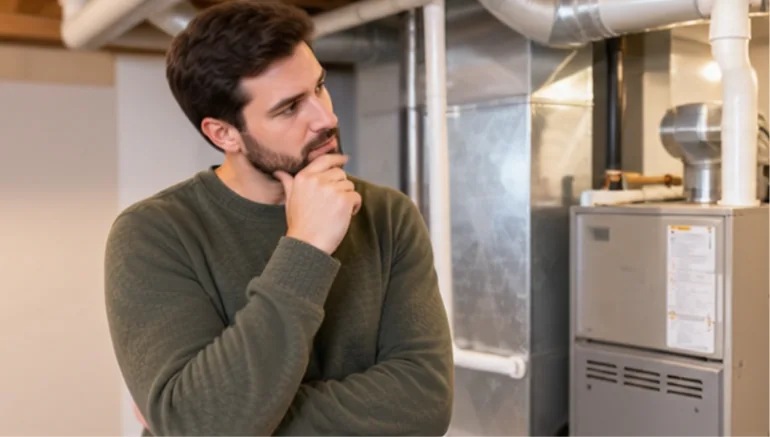

You turn the heat on for the first time all season, something is off, and a technician hands you a repair quote on a furnace that is already 15 or more years old. Spending the money might buy you a season or two, or it might be good money after bad. The frustrating part is that the quote alone does not tell you which. This guide gives you a way to decide whether to repair or replace the furnace, grounded in three tests you can apply yourself.
Repair a furnace when it is under about 15 years old, the fix is minor, and the heat exchanger is sound. Lean toward replacement when the unit is past roughly 15 to 20 years, a single repair approaches half the cost of a new system, repairs are becoming frequent, or the heat exchanger is cracked. Age, repair cost as a share of replacement, and combustion safety are the three tests that settle most cases. Everything below explains how to run them.
How Long Does a Furnace Actually Last?
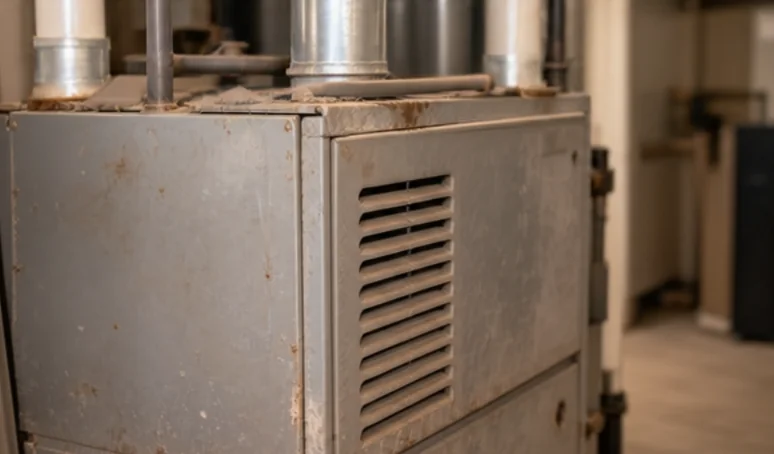
A furnace is the gas-fired unit that heats air and pushes it through your ducts, its working life set by the heat exchanger, burners, blower motor, and control board. Most furnaces last roughly 15 to 20 years.
That range is a planning tool, not a verdict. A furnace maintained, filtered, and sized correctly can run past 20; a neglected one can fail at 12. Age tells you where to start looking, not what to do.
In Marietta, the number bends further. The short, mild heating season means a furnace runs far fewer hours each winter than the same unit would up north. A 20-year-old furnace that worked lightly may have more usable life left than its age suggests, pushing the decision toward condition and repair history.
So age is the opening question, not the closing one. The brand on the cabinet doesn't force replacement either. Parts and service remain available for Carrier, Goodman, Amana, Rheem, York, and American Standard systems as well as Trane and Lennox. Next, we turn age into an actual rule you can apply.
How Do You Decide Between Repair and Replacement?
The decision comes down to three tests, run in order: how old the furnace is, how big the repair is as a share of a new system, and whether combustion is safe. Any one of them can settle it on its own, but most cases sit in the middle, where you weigh all three together.
Age sets the odds. Under about 15 years, repair is usually the sensible call. Past 15 to 20, the unit is on borrowed time and every repair is money spent on something near the end. The repair-share test is the money check: when a single fix climbs toward roughly half of what a new system would cost, the repair stops making sense.
Safety overrides both. A cracked heat exchanger can leak combustion gases into your air, and that is a stop sign regardless of what the age or cost math says.
| Your situation | What it points to | Why |
|---|---|---|
| Under 15 years, minor fix, exchanger sound | Repair | Plenty of life left; the cost is proportionate |
| 15 to 20 years, repair near half of replacement | Lean replace | Spending heavily on a unit near end of life |
| Any age, cracked heat exchanger | Replace or stop use | Combustion safety outweighs the money math |
| Over 20 years, repairs recurring | Replace | Pattern, not a one-off, drives the total up |
Run your own furnace through those rows and you will usually land in one. If two rows disagree, safety and then the repair-share test break the tie. The next section walks through the warning signs that put you in the replacement rows.
What Signs Point Toward Furnace Replacement?
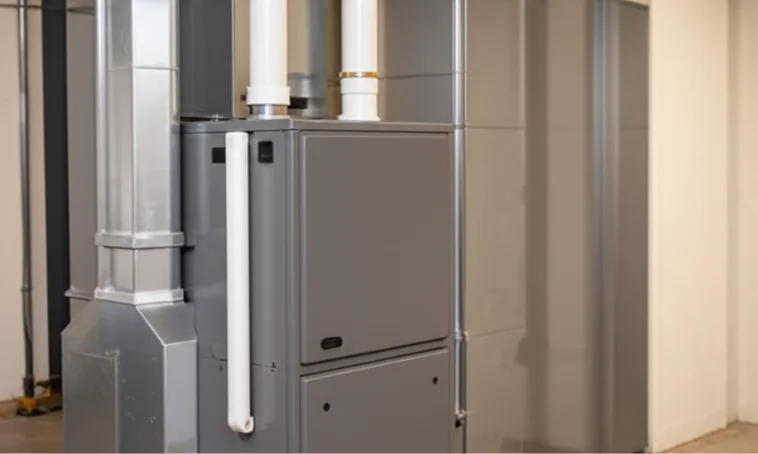
A furnace rarely needs replacement because of one isolated problem. More often, the decision becomes clearer when repair bills keep adding up, rooms no longer stay warm, or the system struggles to complete a heating cycle. These warning signs can help you recognize when another repair may only delay the need for a new furnace.
Repairs Are Getting Frequent and Expensive
One repair in a season is normal maintenance. But 2 or more repairs in a single heating season is a pattern, and patterns cost more than any one invoice shows. Each failure signals that other original parts are near their own end, so you are likely paying for the first of several visits. When the repairs start chaining together, the furnace is telling you it is done.
Rooms Take Longer to Warm and Bills Keep Climbing
If the house takes noticeably longer to reach the setpoint and your gas bill has crept up without colder weather to explain it, the furnace is losing efficiency. Worn burners, a tired blower, or a fouled heat exchanger all make the unit work harder for less heat. On an aging system, this slow decline rarely reverses with a single repair.
A Cracked Heat Exchanger Shows Up
A cracked heat exchanger is a safety stop, not a cost question. The exchanger is the metal wall between combustion gases and the air you breathe, and a crack can let those gases into the house. Verifying it takes a qualified eye; a credible inspection by a Marietta heating contractor with NATE and EPA 608 certification should include showing you the crack, not just reporting it. Keep a carbon monoxide alarm on every level of the home, and if it sounds or you smell gas, leave the house and, once outside, call 911 or Atlanta Gas Light at 877-427-4321.
The Furnace Is Past Three-Quarters of Its Expected Life
Once a furnace passes about 75 percent of its expected service life, roughly 15 years into a 20-year span, the math shifts. Money put into repairs at that point buys a shrinking amount of remaining life. It does not mean replace today, but it means weighing every repair against how few seasons it is likely to protect.
One warning sign alone does not always mean you need a new furnace, but several problems occurring together can make replacement the more practical choice. If your system is still relatively new and the repair is straightforward, fixing it may be the better investment. When continued repairs no longer make sense, explore furnace installation services in Marietta to understand your replacement options.
When Is a Repair Still Worth It?
Plenty of furnace problems are worth fixing, and not every quote on an older unit is a reason to replace. The repair holds up when the unit is relatively young, the failed part is affordable, and the heat exchanger is intact.
Common repairs that usually make sense on a sound furnace:
- Igniter or flame sensor: Small parts behind many no-heat calls, and a fraction of the cost of a new system.
- Capacitor or blower motor: Worth fixing when the rest of the furnace is in good shape.
- A first failure on a well-maintained unit: One breakdown is not a pattern.
Protect yourself from an unnecessary upsell by demanding documentation. Have any suspected cracked heat exchanger or failed component shown to you before you approve a replacement, and ask for a diagnosis that separates what needs attention now from what can wait.
A credible approach diagnoses first, shows you what was found, and does not proceed without your approval. At Innovative Mechanical, LLC, that means flat-rate pricing and no repair made without going over it with you and getting your authorization. If a quote jumps straight to replacement without that, it is fair to ask what, specifically, was tested. The money math is the other half of this, and efficiency is where it gets quantified.
How Much Does Furnace Efficiency Change the Math?
Efficiency is measured by AFUE, Annual Fuel Utilization Efficiency, the share of fuel a furnace turns into usable heat. A BTU is a unit of heat, and the gap between an old furnace and a new one is how many of those BTUs reach your house instead of escaping up the flue.
Take an 80,000 BTU-per-hour furnace drawing the same gas input both times. At 80 percent AFUE, an older unit delivers about 64,000 BTU per hour; at 96 percent AFUE, a high-efficiency unit delivers roughly 76,800. The difference is heat you paid for and lost up the flue every hour it runs.
A new furnace does not automatically mean a big efficiency jump. In Georgia, a new gas furnace can still be 80 percent AFUE, about the same as many 15-year-old units; the federal 95 percent minimum only applies to furnaces made from December 2028. The real gain comes from choosing a 90 percent-plus model, such as higher-AFUE Trane furnaces.
The catch is the short heating season. Fewer cold months mean fuel savings accrue slowly, so payback stretches out longer than it would up north. The efficiency gain is real; weigh it against how few months you run the furnace. For the same reason, some Marietta homeowners compare a new furnace against a heat pump before deciding. Efficiency is one cost driver, but the quote is shaped by several more.
What Drives the Cost of Replacing a Furnace?

Two furnace replacement quotes can differ by thousands because they are pricing different amounts of work, not just different boxes. The furnace is one line; the rest of the job is everything around it.
The main cost drivers are:
- Heating capacity: A correctly sized unit for your square footage, not simply matching the old one.
- Ductwork condition: The ducts that carry the air; many 1980s-to-2000s homes have duct sizing that predates current practice, which can add sealing or resizing.
- Evaporator coil: The AC coil sharing the furnace cabinet; an aging or mismatched coil may need replacing to avoid an efficiency penalty, which is why some homeowners pair the job with AC installation or replacement.
- Electrical and controls: New wiring, a thermostat, or a safety switch upgrade.
- Permit and inspection: Usually pulled by the contractor as part of the job.
Many Marietta-area homes were built in the 1980s through the 2000s, so many of these furnaces are hitting end of life together, often with original ductwork underneath them. When you read a quote, ask which of these drivers it includes, because that is usually where two prices diverge.
Whoever gives you the quote should inspect the system, explain what is causing the problem, and compare repair and replacement without pressure. Our guide to choosing an HVAC contractor in Marietta lists the questions worth asking.
Why Choose Innovative Mechanical, LLC in Marietta?
Deciding whether to repair an aging furnace or invest in a replacement comes down to more than the price of one repair. You need to know whether the existing system can continue heating your home safely and reliably, or whether replacing it makes more sense over the long term. Innovative Mechanical, LLC helps homeowners in Marietta and the surrounding north metro Atlanta area evaluate their heating needs and consider the right next step.
If replacement is the better option, every installation carries our lifetime craftsmanship warranty, and a full system installation includes the first year of maintenance free. As a Trane dealer, we can walk you through equipment options that fit your home and budget.
Whether your furnace needs a targeted repair or it is time to consider a new system, start with an evaluation of its condition, safety, and overall performance. To talk through your furnace and the right path forward before the next cold spell, send us a message or call Innovative Mechanical, LLC at 770.726.7407.
Frequently Asked Questions
How do I find out how old my furnace is?
Check the metal nameplate inside the cabinet for a manufacture date, or decode the serial number, where the first four digits often encode the week and year. An install sticker left by the last service company also usually lists the date. If all three are missing, a technician can often estimate the age from the model series.
Is a cracked heat exchanger always a reason to replace the furnace?
Not always, but it is a safety stop. On an older furnace a crack usually tips the decision to replacement, since the part is costly and the unit is already near end of life. On a newer furnace still well within its service life, replacing just the heat exchanger can make sense, especially if it falls under warranty.
Will a new furnace actually lower my heating bill in Georgia?
It can, but the savings are smaller here than up north because the heating season is short. Moving from 80 percent to 96 percent AFUE cuts fuel waste on every hour the furnace runs, yet with only a few genuinely cold months, the dollar difference may take years to add up to the cost of the upgrade.
Does replacing my furnace mean I have to replace the AC too?
Not necessarily, but they share the cabinet and the evaporator coil. If the air conditioner is also aging, replacing both together often saves on labor and avoids a coil mismatch that drags down efficiency. If the AC is relatively new and healthy, there is no reason to replace it alongside the furnace.
Do I need a permit to replace a furnace in Georgia?
Furnace replacement generally requires a mechanical permit and inspection in most Georgia jurisdictions. A licensed HVAC contractor normally pulls it as part of the job, so you rarely handle it yourself. Confirm the current requirements with your local building department, since rules and fees vary by jurisdiction and change over time.
Keep reading
Guides and Honest Opinions
Why Is My Heat Pump Running Nonstop When It's Cold?
Home Blog Why Is My Heat Pump Running Nonstop When It’s Cold? Go Why Is My Heat Pump Running Nonstop When It's Cold? Your heat pump has been running since early morning, but it barely seems to shut off. If you live in Marietta, GA, this can happen when a winter cold front pushes temperatures […]
Read the guide
Furnace Smells Like Burning the First Time You Turn the Heat On? Here's What's Normal
Home Blog Furnace Smells Like Burning the First Time You Turn the H… Go Furnace Smells Like Burning the First Time You Turn the Heat On? Here's What's Normal The first time you turn on your furnace after months without heating, you may notice a dusty burning smell. If the odor is mild and fades […]
Read the guide
Why Is the Air in My House So Dry in Winter?
Home Blog Why Is the Air in My House So Dry in Winter? Go Why Is the Air in My House So Dry in Winter? Once the furnace starts running, you notice a static shock every time you touch a doorknob, your lips and the skin on your knuckles crack, and small gaps open up […]
Read the guide
No Ductwork in Your Older Marietta Home? What Ductless Mini-Splits Can Actually Do
Home Blog No Ductwork in Your Older Marietta Home? What Ductless Mi… Go No Ductwork in Your Older Marietta Home? What Ductless Mini-Splits Can Actually Do You have a finished attic, a bonus room over the garage, or an addition that often sits 10 to 15 degrees off the rest of the house, and the […]
Read the guide
What SEER Actually Measures and How Much Efficiency Your Marietta Home Needs
Home Blog What SEER Actually Measures and How Much Efficiency Your M… Go What SEER Actually Measures and How Much Efficiency Your Marietta Home Needs You have two AC replacement quotes sitting in front of you. One recommends a 14.3 SEER2 system, the other says 18 SEER2, and the salesperson says going even higher will […]
Read the guide
Replacing an AC System in an Older East Cobb Home: What Homeowners Need to Know
Learn how aging ductwork, home renovations, and improper sizing can affect AC replacement. Discover what to check before installing a new system for better comfort.
Read the guide
