




What SEER Actually Measures and How Much Efficiency Your Marietta Home Needs

Chad FergusonOwner and founder
You have two AC replacement quotes sitting in front of you. One recommends a 14.3 SEER2 system, the other says 18 SEER2, and the salesperson says going even higher will save you more money. The higher number sounds appealing, but it does not answer the question that matters most: how much efficiency does your Marietta home actually need?
SEER2 tells you how efficiently an AC system is rated to operate, but it does not tell you whether that system is properly sized for your home, whether your ductwork can deliver the airflow it needs, or whether the extra upfront cost will make financial sense. Before choosing an efficiency level, it helps to understand what the number measures and what else should be considered when comparing AC options for your home.
SEER2, SEER, and Efficiency Ratings Mean Different Things
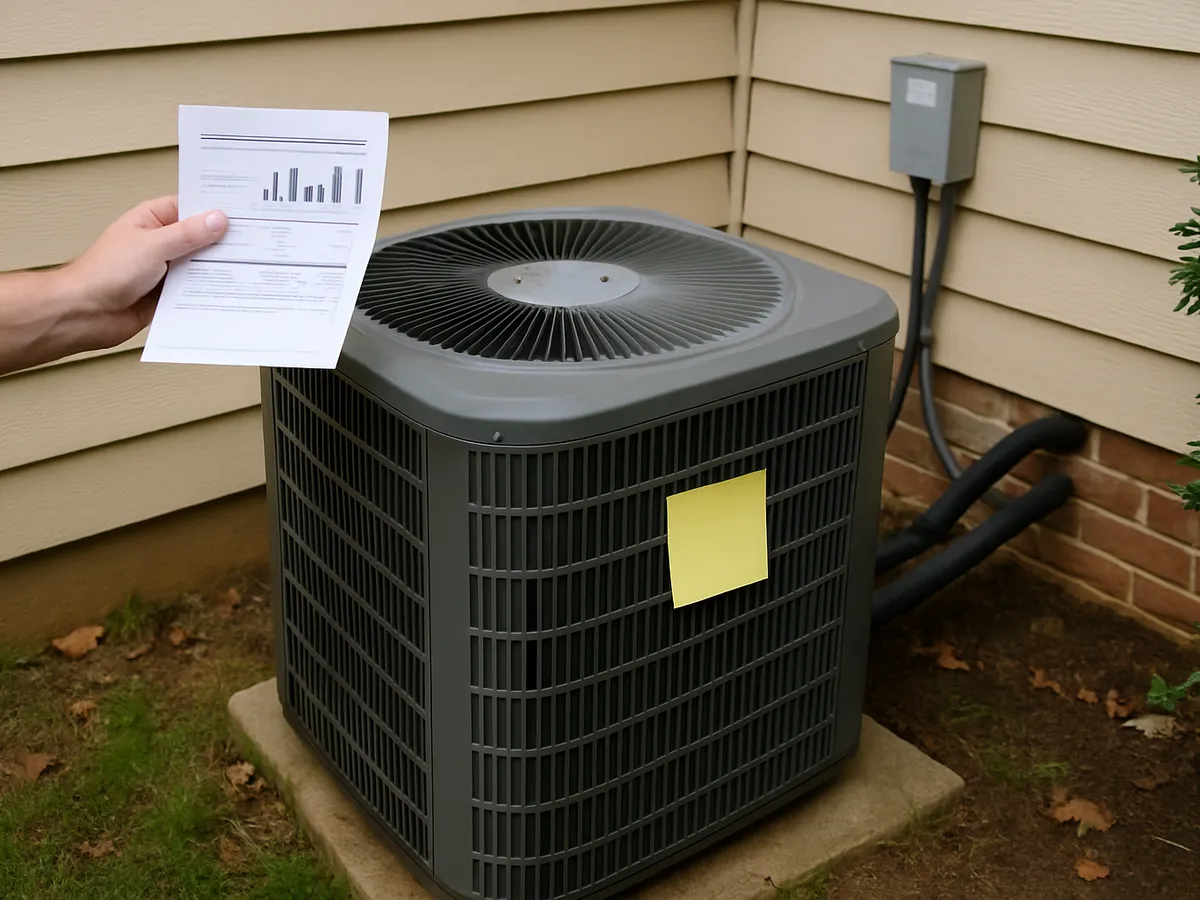
SEER2 is the seasonal efficiency rating used for modern residential air-conditioning equipment. It compares the amount of cooling a system is rated to provide over a standardized season with the electrical energy it uses. A higher SEER2 rating generally indicates greater rated efficiency under the conditions used for testing.
The important distinction is that SEER2 does not tell you how quickly your home will cool, how well every room will stay comfortable, or how much your actual electric bill will be. Those results depend on equipment capacity, sizing, airflow, ductwork, controls, weather, thermostat settings, and how the system is installed and operated.
| What you want to know | What to look at |
|---|---|
| How efficiently the equipment is rated | SEER2 |
| How much cooling the system provides | Cooling capacity |
| Whether the system is correctly sized | Home cooling-load calculation |
| Whether air reaches each room properly | Ductwork and airflow |
| What the system may cost to operate | Efficiency + usage + electricity rate |
| Whether the equipment combination is certified | Complete system information |
So when you see a higher SEER2 number on a quote, think of it as one part of the equipment comparison, not a complete measure of how efficient your home will be.
If the quote is for a heat pump, you will also see HSPF2, the matching rating for heating efficiency. In a home that heats with a heat pump, it deserves as much attention as SEER2.
Why Did SEER Become SEER2?
If you are replacing an older AC system, you may notice that the efficiency number on your new quote does not match the number printed on your old equipment. The Department of Energy introduced the SEER2 testing standard for residential central air conditioners and heat pumps beginning in 2023. The revised procedure uses higher external static pressure during testing, changing how equipment performance is measured.
That means an older system labeled with a SEER rating and a new system labeled with SEER2 were not tested under exactly the same procedure. You should not look at the two numbers as though they were directly interchangeable.
When you compare your old equipment with a new quote, check which rating each one uses, then compare cooling capacity, complete model numbers, and installation scope rather than the efficiency figure alone.
Start With Your Marietta Home, Not the SEER2 Number
The right efficiency level depends on the home where the equipment will operate. A homeowner who runs the AC heavily and expects to remain in the house for many years has a different calculation from someone who plans to move soon or has an older duct system that needs work.
Before choosing an efficiency tier, consider:
- How frequently you run the AC during summer
- How well the home is insulated
- The condition and design of the ductwork
- Whether the existing system is correctly sized
- Your electricity rate (your Georgia Power or Cobb EMC bill shows it)
- How long you expect to own the home
- The upfront price difference between equipment options
- Whether you value additional comfort or operating features
What matters most for your situation?
A higher-efficiency system may deserve closer consideration if the AC runs frequently and you expect to keep the equipment for many years. On the other hand, paying substantially more for efficiency may be harder to justify if your annual cooling use is relatively low or another part of the HVAC system needs attention first.
For a Marietta homeowner, that evaluation can include more than energy consumption. Humidity control, airflow, room-to-room comfort, and proper equipment sizing can all affect how satisfied you are with the replacement system.
Is a Higher SEER2 Rating Worth Paying More For?
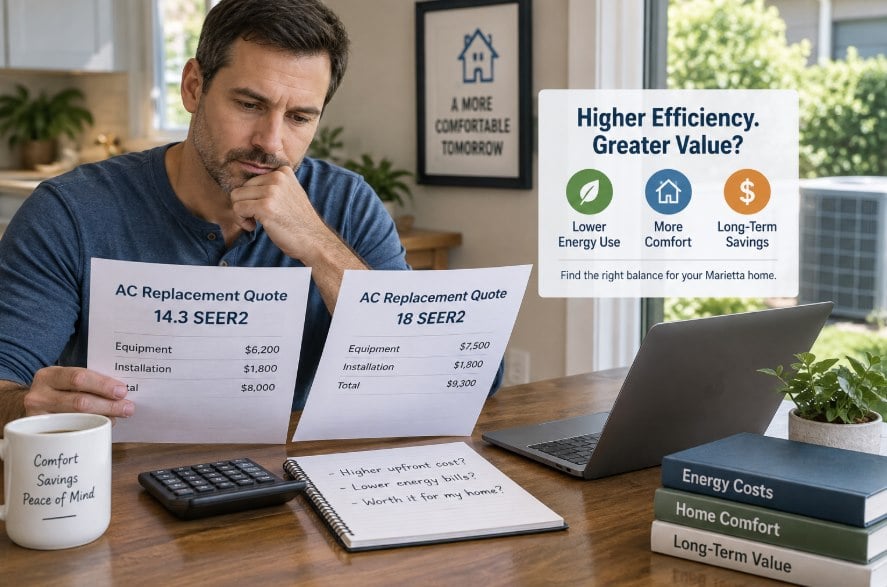
The financial question is straightforward: how much additional money are you spending, and how much could the higher-efficiency system potentially save over the years you expect to use it?
A simple way to understand the calculation is:
Payback period = Additional equipment cost ÷ Estimated annual energy savings
For example, if an efficiency upgrade costs $1,500 more and the estimated annual energy savings were $250, the simple payback would be about six years. That is only an illustration. Actual savings can vary substantially depending on system capacity, operating hours, electricity rates, thermostat settings, weather, home efficiency, and the specific equipment being compared.
The goal is not to find the biggest SEER2 number available. It is to understand whether the additional efficiency and features provide enough value for your particular home and budget.
What Can Keep a High-Efficiency AC From Performing Well?
A high SEER2 rating looks good on a replacement quote, but the number alone cannot guarantee lower bills or better comfort. If the system is poorly sized, the ductwork has problems, or the installation does not match the home's needs, you may not get the results you expected from the efficiency rating.
Before paying extra for a higher-rated system, look at the conditions that can affect how your new AC actually performs. These are some of the areas worth discussing with your contractor:
- System sizing: The AC should match your home's actual cooling needs, not simply replace the old unit.
- Ductwork condition: Leaky or restricted ducts can make it harder to deliver conditioned air throughout your home.
- Airflow balance: Rooms that stay warmer may point to airflow issues rather than insufficient SEER2.
- Equipment combination: The indoor and outdoor components should be properly matched for the advertised efficiency rating.
- Installation quality: Even efficient equipment needs to be installed according to the manufacturer's requirements.
- Home efficiency: Insulation, windows, air leaks, and other conditions affect how hard your AC must work.
- Humidity control: In Marietta's humid summers, this is where higher-efficiency equipment often earns its keep. Many higher-SEER2 systems are two-stage or variable-speed, and their longer, low-speed run cycles remove more moisture than a single-stage unit that cools quickly and shuts off.
- Actual usage: A higher efficiency rating may have greater value when your AC runs frequently throughout summer.
Industry quality-installation guidelines, including ENERGY STAR's, treat proper sizing, airflow, refrigerant charge, and duct evaluation as core parts of a good install. If you are arranging AC installation in Marietta, ask how the contractor determined the equipment size and whether the existing ductwork was evaluated. A higher SEER2 rating cannot by itself correct an airflow problem or a system that is not properly matched to the home.
If your home already has comfort or airflow problems, identify those issues before deciding how much to spend on a higher SEER2 rating. A contractor who looks at the whole system can help you determine whether the extra efficiency addresses your needs or whether another improvement deserves attention first.
What Are Georgia's Minimum Efficiency Requirements?
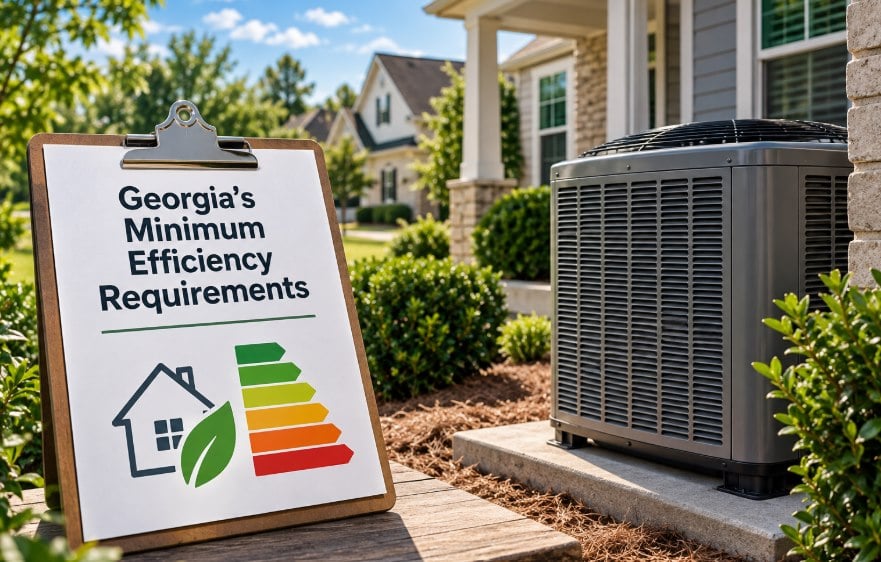
Georgia falls within the federal Southeast region for residential central air-conditioner efficiency requirements. For split-system air conditioners installed since January 1, 2023, the minimum is 14.3 SEER2 for systems below 45,000 Btu/h (roughly 3.75 tons) and 13.8 SEER2 for systems at or above that size. Heat pumps must meet 14.3 SEER2 nationwide, along with a 7.5 HSPF2 heating minimum.
This matters when comparing older equipment with a new replacement proposal. A homeowner may see an older system labeled with a familiar SEER number and assume the same rating can simply be carried over to a new installation, but current equipment requirements and the applicable system characteristics need to be considered.
If you are unsure whether a particular replacement system meets the applicable requirements, ask the contractor to verify the exact equipment combination rather than relying on a generic efficiency chart or an older quote.
Ask These Questions Before Choosing Your Efficiency Level
You do not need to understand every HVAC specification to have a useful conversation with your HVAC contractor. You simply need enough information to understand why the proposed system fits your home and what you are paying extra for.
Before approving the installation, ask:
- How did you determine the required system size?
- What are the cooling capacity and SEER2 rating of the complete equipment combination (and the HSPF2, if it is a heat pump)?
- What is the price difference between the efficiency options?
- What annual energy-savings estimate are you using, and how was it calculated?
- Did you evaluate the existing ductwork and airflow?
- What additional features, such as two-stage or variable-speed operation, come with the higher-efficiency system?
- What startup and performance checks will be completed after installation?
Having these answers before you approve the replacement can make the differences between two AC quotes much easier to understand. You can see whether you are paying for useful efficiency, additional comfort features, or simply a higher number on the proposal, and make your decision based on what your Marietta home actually needs.
Frequently Asked Questions
Does a higher SEER2 system cool my house faster?
No. SEER2 measures rated seasonal efficiency, not cooling speed. Cooling capacity, proper sizing, airflow, and system design have a greater influence on how quickly the home reaches the desired temperature. A variable-speed high-SEER2 system may actually run longer at low speed, which is by design and helps with humidity.
Is 14.3 SEER2 enough for a Marietta home?
It can be an appropriate efficiency level for some homes, provided the equipment meets the applicable requirements and is properly sized and installed. Whether a higher rating is worth the additional cost depends on your home's cooling demand, operating costs, equipment price, and expected time in the home.
Can high-SEER2 equipment fix uneven cooling?
Not by itself. Uneven temperatures can result from duct leakage, restricted airflow, inadequate return air, insulation problems, system sizing, or other issues. Those conditions should be investigated rather than assuming that a higher efficiency rating will solve them. Measuring airflow room by room usually points to the actual cause.
Does SEER2 tell me how much my electric bill will decrease?
No. SEER2 provides a standardized equipment efficiency rating. Your actual electricity savings depend on how the system operates in your home, including cooling hours, system capacity, thermostat settings, electricity rates, home efficiency, and installation conditions.
Is 20+ SEER2 automatically worth the extra cost?
No. A higher rating may reduce electricity consumption, but the financial value depends on the additional purchase price and the amount of energy the system is expected to save. Compare the complete systems and the actual price difference before deciding. A top tier makes the most sense when the AC runs heavily and you plan to stay in the home for many years.
Why Choose Innovative Mechanical, LLC for AC Installation in Marietta?
When you are replacing an air conditioner, the SEER2 number is important, but it should not be the only thing used to choose the system. The equipment needs to be appropriate for the home's cooling requirements, properly matched, correctly sized, and installed so the system can deliver the comfort and efficiency you paid for.
As a Trane Authorized Dealer, Innovative Mechanical can quote more than one efficiency tier and show you the options side by side, so you can see what the extra SEER2 actually buys. Replacement decisions are built around the home's actual needs rather than the highest rating on the sheet, and every installation is backed by a lifetime craftsmanship warranty. If your existing system has uneven cooling, airflow concerns, or other performance problems, those conditions can be evaluated as part of the replacement discussion.
If you are comparing AC replacement options and want to understand whether the proposed efficiency level fits your home, call 770.726.7407 to schedule a home visit and discuss the equipment, sizing, and installation requirements before you commit to a system.
Keep reading
Guides and Honest Opinions

How to Choose an HVAC Contractor in Marietta
Looking for a trusted HVAC contractor in Marietta? Learn what to look for, important questions to ask, and how to choose the right company for reliable heating and cooling services.
Read the guide
Why Is My Heat Pump Running Nonstop When It's Cold?
Home Blog Why Is My Heat Pump Running Nonstop When It’s Cold? Go Why Is My Heat Pump Running Nonstop When It's Cold? Your heat pump has been running since early morning, but it barely seems to shut off. If you live in Marietta, GA, this can happen when a winter cold front pushes temperatures […]
Read the guide
Furnace Smells Like Burning the First Time You Turn the Heat On? Here's What's Normal
Home Blog Furnace Smells Like Burning the First Time You Turn the H… Go Furnace Smells Like Burning the First Time You Turn the Heat On? Here's What's Normal The first time you turn on your furnace after months without heating, you may notice a dusty burning smell. If the odor is mild and fades […]
Read the guide
No Ductwork in Your Older Marietta Home? What Ductless Mini-Splits Can Actually Do
Home Blog No Ductwork in Your Older Marietta Home? What Ductless Mi… Go No Ductwork in Your Older Marietta Home? What Ductless Mini-Splits Can Actually Do You have a finished attic, a bonus room over the garage, or an addition that often sits 10 to 15 degrees off the rest of the house, and the […]
Read the guide
Replacing an AC System in an Older East Cobb Home: What Homeowners Need to Know
Learn how aging ductwork, home renovations, and improper sizing can affect AC replacement. Discover what to check before installing a new system for better comfort.
Read the guide
Why Is My AC Running But Not Cooling? (A Marietta Homeowner's Guide)
Is your AC running but not cooling your home? Learn the most common causes, simple troubleshooting steps, and when to schedule professional AC repair in Marietta.
Read the guide
